
This is our first serious step away from Earth. It’s 400,000 kilometers away, a minimum 7-day one-way trip, and it has its own gravity well. In Earth Orbit, if you want to go home, you just slow down a bit, and gravity will always take you home. Not so with Luna; a ship leaving Low Earth Orbit for Luna must accelerate by a bit more than 3 kps to Earth-Moon transfer. Then it’s all downhill to Luna, you’re going to gain a bit more than 2.5 kps falling into its gravity well. There’s no atmosphere to burn off speed, so you need fuel for that as well. So, 5.5-6.0 kps to get there. Coming home, you need to climb back out of that gravity well, 2.5 kps, but once you start falling towards Earth, you can burn all your extra velocity off by ‘aerobraking’ in Earth’s atmosphere. So, assuming you don’t die screaming in your melting spaceship because you didn’t aim right, a round-trip LEO-Luna-LEO is eight to nine kps (your mileage may vary). That’s not much different than going to Mars! It’s only 9.5 kps round-trip because both planets have atmospheres that you can use to burn off extra velocity. So, counterintuitively, it takes roughly the same effort for the seven-day trip to the moon as it does for the seven-month trip to Mars.
It’s airless, which means full spacesuits whenever we go out for a whiz. Gravity is 1.625 m/sec/sec, about 17% of Earth’s. On Earth, if you drop something off the edge of a building, it will fall just under 5 meters in the first second. On Luna, it will fall a bit less than a meter. Big difference, our bodies will need to re-learn how to navigate in such a weak gravitational field. Since the moon revolves around the Earth in 28 days, there will be 14 days of sunlight and 14 days of darkness, which is problematic from power-generation and food-growing perspectives. Also, that results in huge temperature swings, from 100+C during the day to- 170 °C at night. Ick. However, there are areas around the rim of Shackleton Crater near the south pole which receive ALMOST continual sunlight, and a much more stable thermal environment, a roughly continuous minus-50 °C. Lunar dust COULD be a problem, as it gets into everything, but on the other hand it could also be a resource as its easily mined and may contain several useable products.
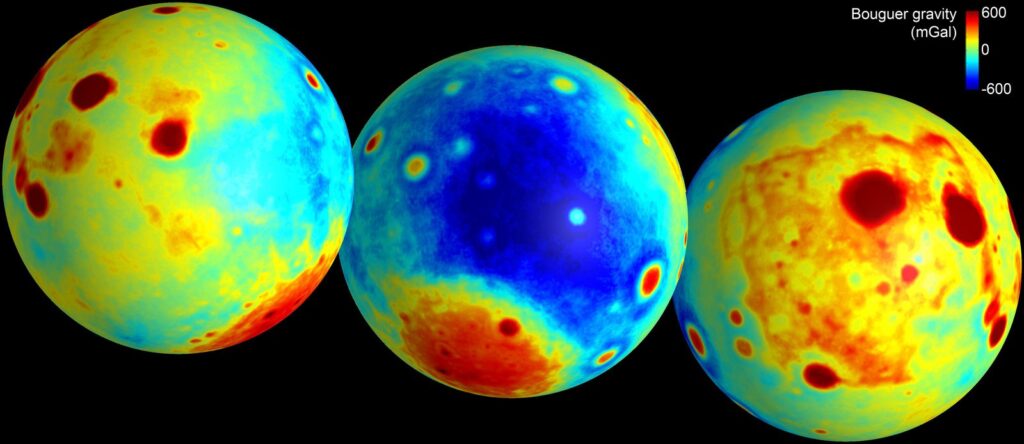
Gravitational anomalies on Luna, with red being high and blue being low.
So, is there any reason to found a colony on Luna? Beaver furs for hats? Cities with streets paved with gold? Fuel for our spaceships?
Well. No. Not that we know of today, anyway.
But that could change. Artemis II is scheduled to fly around the moon sometime in early 2026, and Artemis III intends to land humans near the south pole. This is a Big Deal, because we’re pretty sure there is a significant volume of water ice in the permanently-shadowed craters near the north and south poles. If the volume is sufficient (millions of tons), we could use it to make breathing air and rocket fuel, and to grow food. It is also possible to retrieve oxygen and possibly water from lunar regolith, but the cost-benefit is uncertain, to be charitable.
All that could change as and when other near-Earth locations are colonized. Lunar regolith is rich in Iron, for example, and the transportation cost from Luna to L5 or Earth Geosynchronous is MUCH less than from Earth’s surface. As a thought experiment, let us say that the cost of smelted iron on Earth’s surface is $0.25/kilo (it is), and that SpaceX drives the transportation cost down to $100/kilo from its current $2000/kilo. So a ton of smelted iron delivered to Lagrange Point Five – say enough for a steel beam – would cost $100,250.00. If you could produce smelted iron on Luna for 100x the cost of Earth smelted iron, $25.00/kilo, the delivered cost to Lagrange Point Five or Geostationary Orbit with the same SpaceX ship would be much less than $50,000.00. Lifting heavy items out of a deep gravity well is expensive, and it turns out that Luna’s greatest natural resource, and to a lesser extent Mars’, is its relatively shallow gravity well.
So, a recurring theme here. Like the Lagrange Points, Luna is currently a possible solution without a problem. Once we start moving into places like Geostationary Orbit, someone can make a buck by leveraging Luna’s shallow gravity well. And if there’s money to be made, someone will go for it.
Note: To make the image larger, right-click on it and select ‘open image in new tab’.
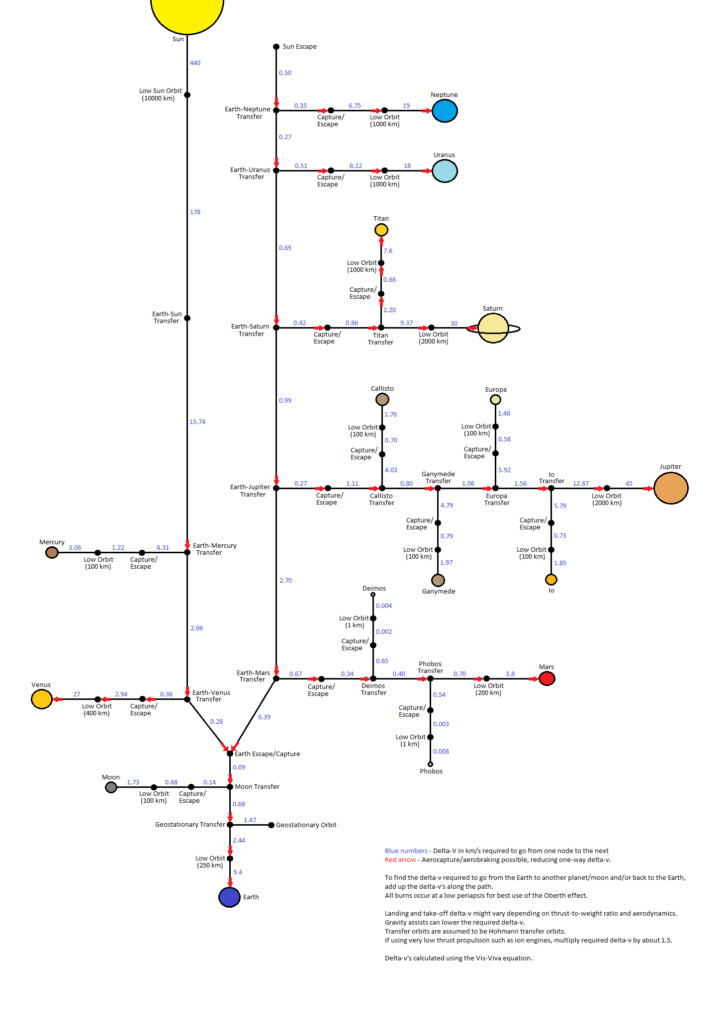
This is a very handy delta-vee map to help you plan your energy budget around the Solar System. Don’t leave home without it!