
So, if we’re going to leave and not come back, where would we go? What are our options? It’s easy to say “The sky is the limit!”, but in reality, physics and technology set the limits, and in today’s world, that gives us a somewhat narrow range of options. They are the Earth-Moon System, which includes various Earth Orbits, the Lagrange Points, Luna, and Mars. Each has its advantages and disadvantages, but all are achievable with today’s technology. I’m going to talk about the easiest, closest option – Earth orbit – in this post.
.
Earth Orbits
This is the logical place to start, as it is the closest, the cheapest to reach in terms of delta vee (the change in velocity required), and the safest in terms of re-entry velocity. And, indeed, we already have. The ISS has been continuously occupied for 25 years! In no way could we spin this as ‘colonization’ – it’s a government-sponsored flag-waving program at best – but we’ve learned a lot. And the Chinese have established a smaller, but much newer, lighter, and more modern space station, which has been continuously occupied for 5 years.
Both of these buildings reside roughly 400 kilometers above Earth’s surface, in what we call Low Earth Orbit (LEO), which extends from 160 to 2,000 kilometers in altitude. 400 kilometers is the current sweet spot between the ease of getting up and down (lower is better) and the need to continually re-boost the station so it doesn’t fall out of the sky due to atmospheric drag (higher is better). Would this work for a long-term, stable community? The ISS loses roughly 100 meters of altitude per day to atmospheric drag, and it needs to be ‘boosted’ by a visiting spacecraft roughly once per month. Would YOU invest in a community that will fall out of the sky the minute your back is turned? So, while superficially attractive, it’s really not an option for a long-term stable colony.
This 400-kilometer ‘shell’ is also just below the heavily-used 400-500 kilometer zone, which is the nominal orbital height for communications satellites requiring low latency (e.g., Starlink). That zone is no place for a colony; it’s busy now, and it’s going to get MUCH busier as time passes. At 600 kilometers, we enter an area that is periodically subject to intense radiation from the lower Van Allen Belt, and at 800-1,000 kilometers, we enter the zone of maximum space debris, which is mostly legacy rocket bodies from decades ago. Debris in this zone takes a long time to clear itself, so until we clean it up, it’s not a happy place for a long-term habitat. Also, we’re entering the lower Van Allen Belt, an area of often intense radiation that you do not want to be in. So in conclusion, no colonies in LEO, please. It’s our future commercial-light industrial zone, not the place for a nice country home.
Next up is Medium Earth Orbit, which lies from 2,000 to 36,000 kilometers above Earth’s surface. The lower region, from 2,000 to 10,000 kilometers, is an area of intense radiation called the Lower Van Allen Belt. This is not a nice place for pale, squishy humans, and it is also tough on rigging for buildings. From 12,000 kilometers to 36,000 kilometers, the Upper Van Allen Belt subjects anything passing through it, or residing within it, to comparable levels of intense radiation. Having said that, numerous satellites are positioned there, particularly GPS satellites, as that is home to the very valuable 12-hour orbital period, which places satellites over exactly the same spot twice per day. And you may have noticed a ‘slot’ between the two belts, which is actually quite a low-radiation environment. Until the belts move, which they do, and then it’s not nice. So it would likely be feasible to locate a building in the slot, but it’s definitely subject to Bad Hair Days when the sun acts up. Again, not a good place for our nice country home. The 12-hour orbit, and later the 6-hour orbit, WILL host communities in the future, as they are excellent locations for customs depots, refueling stations, grocery stores, etc., for ships coming and going. But that’s all for later.
.
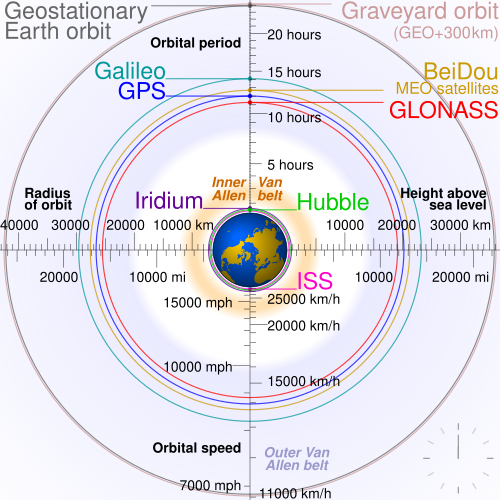
A more-or-less-to-scale diagram of Earth’s orbits and their current occupants.
.
Next comes the Geosynchronous Orbit, at roughly 35,786 kilometers altitude. This is an extremely popular orbit because its orbital period matches Earth’s rotation period. In a geosynchronous orbit located along the equator, called a Geostationary Orbit, satellites appear to hang motionless above a point on Earth, which makes this orbit an excellent location for communications satellites that don’t need to worry about latency (e.g., television, weather monitoring). While still inside the Outer Van Allen Belt, it is outside the most intense radiation. So a colony would work there, but it would still need significant hardening against radiation from both the Van Allen Belt AND from space, as we’re now outside most of the protection provided by the Belts. The two main drawbacks are that this is very high-value real estate, and traveling to and from Earth’s surface is relatively expensive due to the increased delta-vee. Moving from the ISS’s orbit to GEO, for example, requires a minimum of 2.4 to 3.9 kilometers per second of extra velocity.
There IS an intriguing possibility near Geostationary Orbit, however. A colony roughly 75 kilometers higher than Geostationary Orbit would have an orbit period 236 seconds longer, and the colony would move 1/365th of the way around the orbital path each day (roughly 725 kilometers), coming back to exactly where it started in one year. It would be comfortably out of the way of the communications satellites and associated traffic, and it could service Earth’s GTO satellites, with its orbit visiting each one annually. Satellite operators would welcome a refueling/inspection/repair service, as these satellites are very large and very expensive, in part because of the need to carry sufficient fuel for periodic station-keeping. An annual refueling service, for example, would mean that satellites could last longer before replacement, could be smaller because they need to carry less fuel, and would cost less to launch due to the reduced mass. There’s a business case there today! And of course, that servicing role would morph into replacement, repair, reconstruction, etc. An industry. I’m sure that someone would write a song with lyrics like “It must be spring, I’m looking down at Paris.” And if you don’t like that orbit, there’s another one just thirty kilometers higher in which the colony would amble around the planet every six months, visiting the GTO satellites twice a year.
In summary, the LEO options for long-term habitation leave much to be desired, while there are a few promising options in MEO once we sort out the radiation shielding and generate a need for people to be there. The shells just above GTO are very promising, and there is work there to justify it right now.