
The Early Mars Series
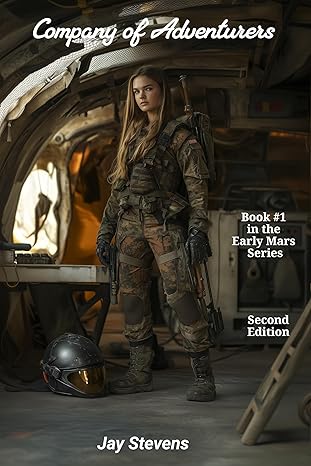
Company of Adventurers
Mars is hard. It’s always looking for new and exciting ways to kill you. The Company has been there for twenty years now, Homestead is growing quickly, and they have even started a second community. It looks like they’re going to make it. Or will they?
They have just found out the hard way that someone else believes that there’s only room for one colony on Mars, and it isn’t Homestead. And if that wasn’t enough, there’s big trouble brewing inside the colony. So, how do you keep your people safe when you have no weapons, no military, no police? How do you enforce the law when there is no law?

A Land So Wide and Savage
Humans have been living on Mars for 55 years. The Company communities are thriving, and five Earth nations have established neighbouring colonies. The hardest part is over, and for the nearly 15,000 people on Mars life is good.
Still.
Anders Saugstad, the Mandate’s aging security chief who led the relief force from Earth back in the War of Fifty-Two, can’t shake off his suspicions that something is just not quite right. His discrete enquiries to old friends in military intelligence back on Earth turn up the unsettling truth; two of his new neighbours want the Mandate for themselves and they are preparing to bring soldiers and heavy weapons to Mars to make that happen.
The failure of diplomatic efforts to stop the launches leads to humanity’s first military fleet actions in space, leaving six nuclear nations on the brink of open war. Meanwhile, the Mandate and its friendly neighbours frantically prepare to meet the remnants of the space fleet in battles that will determine whether Martians will live beside each other in mutual trust and goodwill or according to the old hatreds brought from Earth.
Dominion
July 29, 2116.
That’s the day the vested interests back on Earth, the corporate heads, the union bosses, the political heavyweights, woke up and smelled the methane. Mars was no longer a convenient and dependable revenue source, a cost-plus project funded by the taxpayers. It had become a competitor.
The Alliance, a partnership of convenience between the Western nations, was engaged in a planet-wide struggle with the Islamic Republic of the Mediterranean. They were holding their own, but it was a precarious alliance at best, and the last thing they needed was a brash young competitor like Mars upsetting the complex web of obligations that kept the member nations together. Better they quickly squish the Martian upstarts like a bug so that they could get back to fighting each other.
Mars didn’t see it that way. Well, at least some people on Mars didn’t, and they were prepared to defend their interests by force. Somehow, a simple commercial transaction threatened to precipitate a civil war on Mars, a shooting war between Mars and Earth, and a world war back on Earth, possibly all at the same time.
Could anyone unravel this? Find some way to get everyone to go sit in the corner and think about what they had done? And if not, would anyone survive?


The New Frontier
Aliens. It’s 2140, and a tiny colony on Europa stumbles on incontrovertible evidence that aliens exist in our solar system. Right here, right now. Who knew? One day you’re shoveling snow at one of Europa’s vents, the next you’re picking through the remains of a submarine full of little aliens.
The leaders of the Martian Federation and the Earth Alliance quickly agree to assemble a joint expeditionary force to establish contact and to communicate with these, our first sister species in the universe. There are, however, a few minor problems.
The aliens are at the bottom of a thirty-kilometer-deep ocean, under six kilometers of ice, on a cold and airless moon of Jupiter that is bathed in lethal radiation. And there’s no living space available for the expeditionary force to stay under the ice with the colonists, while staying on the surface is impossible because of the intense radiation.
These problems would be much easier to deal with if the Alliance and the Federation weren’t on the brink of breaking off relations, and if the Alliance leadership weren’t grappling with their own internal issues. Not to mention that the colonists, who own the only habitable spaces on Europe, can’t stand either of them.
Can humanity stop fighting for long enough to solve all these problems? And if so, what kind of intelligence can they expect to find under the ice and at the bottom of a lightless ocean with no view of the universe?