
Are we there yet? Why is this taking so long?
My last few posts explored whether we are even capable of transporting people to Mars, and the answer is almost certainly yes. We can do it, and we can do it with today’s technology, but it won’t be fun. The trip will be cramped, boring, stressful, and dangerous, and it will take a long time. So let’s explore whether we have realistic options to make the trip better.
But first, what would “better” look like?
It could mean faster. For example, shortening that six-month trip to three months would reduce Leonard’s exposure to risks, such as Coronal Mass Ejections, reduce his stress, and cut the mass of food, water, and air in half. In short, it would confer many tangible benefits. So why don’t we do that? Sure, it will use more fuel, but it can’t be THAT much, can it? It should be pretty easy to figure out, so let’s take a look.
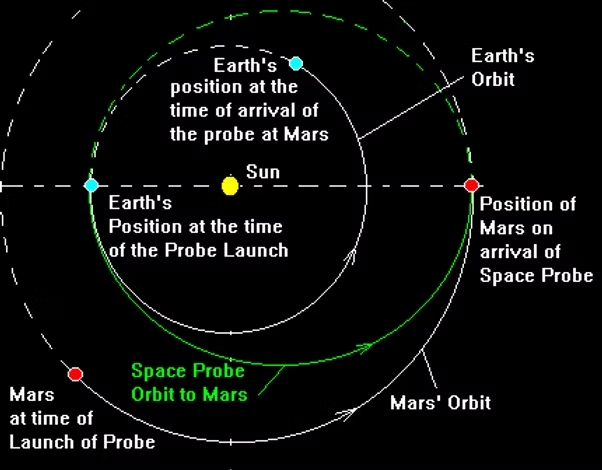
How a Hohmann Orbit Works.
.
Our planet travels around the Sun in an ellipse, varying from a distance of 147M km to 152M km, at approximately 30 kilometers per second. To get to Mars, we add speed in the direction that the Earth is traveling by 3.8 kilometers per second, and our intrepid little spacecraft will alter the ellipse so that the aphelion (furthest point from the Sun) is in Mars orbit and the perihelion (closest point from the Sun) is in Earth orbit. Our spacecraft will climb away from the Sun (uphill) for (more or less) seven or eight months, and then drop back (downhill) to Earth orbit for the next seven or eight months, at which time the Earth will no longer be there, but there you go. (If you added a teensy more velocity and made the trip each way in six months, Earth would be there waiting for you when you returned!) That least-velocity ellipse is called the Hohmann Transfer Orbit from a guy named, you guessed it, Mister Hohmann. We can easily shorten the time to six months by adding a modest amount of velocity. The ideal Hohmann Orbit requires approximately 3.8 kilometers per second, while you can purchase a six-month orbit at the ticket office for an additional 0.5 kilometers per second. But getting travel time much below that takes more fuel, less payload, or a new ship with a bigger fuel tank. At some point, we can’t do it at all because the amount of fuel required is unrealistic.
I’ve added a “porkchop plot” below depicting the 2026 launch window to give you a better sense of the relationship and the trade-offs between launch date, change in velocity (delta-v), and trip length. These numbers are based on several assumptions and are approximate. The “cheapest” window (center of the light blue) is 210-240 days, but for a modest increase in fuel, we can shorten the trip to 180 days.
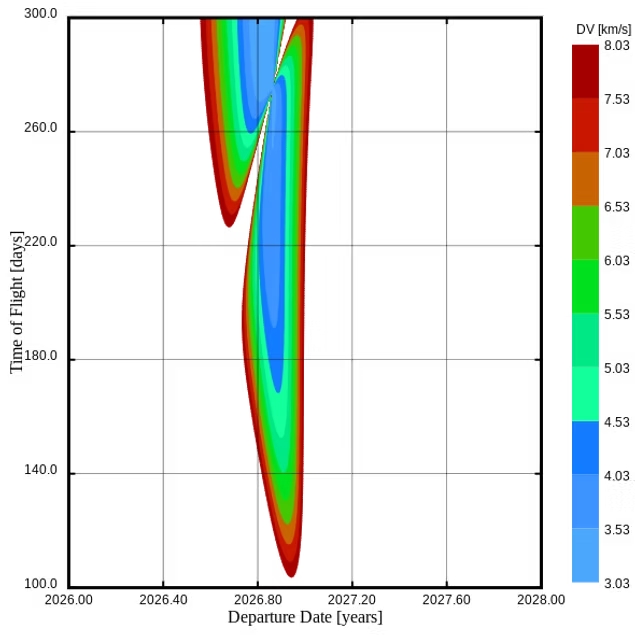
Porkchop Plot for the 2026 Earth-Mars Launch Window.
.
The trip to Mars in our previous post assumed a change in velocity of 4.35 kilometers per second, which, in a good launch window (every window is different in this solar system as the orbits are not perfect circles), delivers a 180-day travel time. That assumed a total ship mass of 125 tons, of which 85.5 tons was fuel, and an exhaust velocity of 3.43 kilometers per second, which is the current output of the SpaceX Raptor Vacuum engine. If we wish to shorten that trip time from six months to three months, we would need to travel along the ellipse that crosses Mars orbit in three months, rather than six months, and it looks like this.
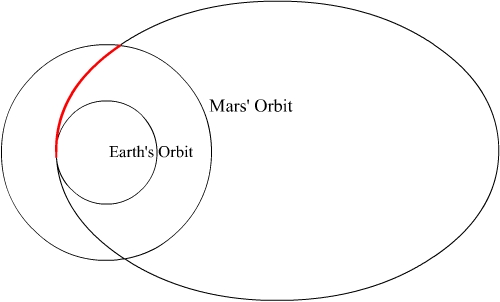
The red line is a 90-day path from Earth to Mars.
.
Okay, how much of a change in velocity will we need to achieve that ninety-day ellipse? Well, that’s the icky part. That ellipse requires an acceleration of thirty kilometers per second from LEO, and when you get to Mars, you will zip past at twenty-five kilometers per second if you don’t slow your ship down. Our existing ablative materials can only withstand eight or nine kilometers per second of aerobraking, so we will need more fuel to slow down another seventeen kilometers per second and we will need extra fuel at the beginning of our trip to transport that extra fuel.
The Tsiolkovsky Rocket Equation (independently derived by at least four people over the years but attributed to Tsiolkovsky) helps us sort all of this out. It works with the exhaust velocity of the rocket, the initial “wet” mass, the final “dry” mass, and the total change in velocity (delta-v). If you have any three terms, you can derive the fourth.
There is a convenient online calculator,
(https://www.omnicalculator.com/physics/ideal-rocket-equation)
which is an excellent tool to illustrate the implications of rocket efficiency on the payload. Plugging our numbers in, we find that to accelerate our thirty-five-ton ship by forty-seven kilometers per second, we will need – just a tad over thirty-one million tons of fuel. Well, that ain’t gonna happen. Suppose we found some magical material that would allow us to aerobrake all of our excess speed in Mars’s atmosphere. Then we would need to accelerate our ship by only thirty kilometers per second! Well, that would require just 220,000 tons of fuel. Keeping in mind that our pusher unit, the Falcon Heavy Second Stage, can hold a maximum of 107.5 tons, that is also obviously impossible. Well then, let’s work with what we’ve got. If the maximum that our pusher unit can carry is 107.5 tons, how much can we accelerate our thirty-five-ton spacecraft? The Rocket Equation gives us 4.816 kilometers per second, and our Porkchop Plot indicates that 4.816 kilometers per second will buy us a trip time of – 160 days.
So that’s it. If we send up another Falcon 9 with 22 tons of fuel and figure out some way to refuel our pusher unit in space, we reduce the trip time from 180 to 160 days. If we want to shorten trip time beyond that, we need a fundamental change in technology, such as nuclear-thermal rockets. Going back to our rocket equation, increasing our exhaust velocity to 6,000 meters per second with nuclear-thermal would get us there in ninety days.
Sadly, we are bereft of nuclear-thermal pusher units, as we abandoned the highly successful and very promising experiments in nuclear-thermal rockets 50 years ago. Before we proceed further, let’s do a quick flip through Rocket Propulsion 101.
Chemicals, either solid or liquid, power all of our current stable of rockets. The chemicals combine to produce expansion (for example, ‘burning’ kerosene in oxygen), which is directed out the rear of the vehicle. The higher the combined volume and velocity of the expelled gases, the greater the thrust, and the greater the acceleration of the vehicle. Each combination of chemicals has a different efficiency, and we commonly measure that as ISP, or “specific impulse”. For example, one kilogram of fuel that can generate one kilogram of thrust for 200 seconds has an ISP of 200. ISP and exhaust velocity are directly related; if you multiply the ISP by 9.82 (gravitational acceleration on Earth’s surface) you get the exhaust velocity (in this case 200 * 9.82 = 1962 meters per second). Below is a list of commonly known rocket fuels and their ISPs.
.
| Fuel | Vehicle It Was Used In | Specific Impulse (ISP) |
| Polybutadiene acrylonitrile | Space Shuttle Solid Rocket Booster | 250 |
| Kerosene/Liquid Oxygen (keralox) | Saturn V First Stage | 265 |
| Kerosene/Liquid Oxygen (keralox) | Russian RD-80 Vacuum | 315 |
| Kerosene/Liquid Oxygen (keralox) | Falcon 9 Merlin Vacuum | 350 |
| Methane/Liquid Oxygen (methalox) | Starship Raptor 2 Vacuum | 380 |
| Liquid Hydrogen/Liquid Oxygen | Saturn V 2nd/3rd Stages | 420 |
.
But it almost didn’t play out this way. Seventy years ago (yes, 70 with a 7!), the US military launched Project Rover to explore the possibility of putting a nuclear-thermal upper stage onto Inter-Continental Ballistic Missiles (ICBMs). The Soviet Union was a serious adversary back in the early-to-mid 1950s; the USA didn’t have rockets with sufficient “throw weight” to carry large, heavy nuclear bombs to all parts of the USSR, and nuclear-thermal had the potential to double, even triple, the ISP and hence substantially increase payloads. They debated the concept for several years before finally launching the project in 1957 at Los Alamos, New Mexico. They hoped to develop a nuclear rocket that could deliver 2,700 megawatts of power. It was very promising, but chemical rockets were getting better, and nuclear weapons were getting smaller, so that initial rocket morphed into a solution in search of a problem.
Then, just as politicians began openly considering pulling the plug on Project Rover, the Soviet Union launched a payload into space, and a year later, they put a human into orbit. The race was on. Nuclear-thermal upper stages were a very promising option for the Apollo Program, and development proceeded for several years under Project Kiwi (ground-testing, hence the flightless bird reference) and then NERVA (Nuclear Engine for Rocket Vehicle Application), which included the pumps, engines, etc., to make an operating vehicle. The goal was to develop a 1000 MW (that’s 1.3 million horsepower!) nuclear-thermal rocket with a thrust of 25 tons and an ISP of 825 or more. NASA had big plans for nuclear-thermal, including a moon base, a manned mission to Mars, missions to the outer planets, and a space tug for moving low-orbit spacecraft into higher orbits. Those are all the things we’re talking about right now, 60 years later!
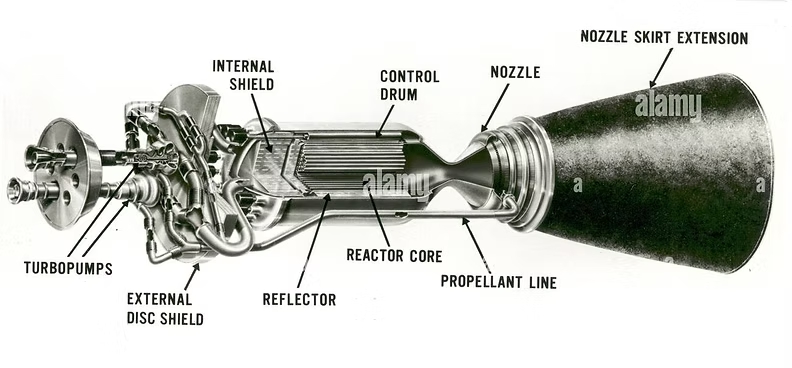
Diagram of a generic NERVA rocket.
.
The NERVA program proceeded from 1964 until it was terminated by President Richard Nixon in 1973. A failure, one would think. But no, NERVA was a resounding success, with the program meeting or exceeding every stated goal. The final rocket, XE Prime, weighed 18 tons, generated 1137 megawatts of power and 27 tons of thrust, and had an ISP of 840+. NASA built six iterations of NERVA between 1964 and 1969 that all achieved similar or greater performance, ran at full power for over two hours, and shut down and restarted dozens of times. Here’s a short list of the NERVAS that were built and a few of their specs.
.
| Engine | Date Tested | Continuous Run Time | Power Generated | Specific Impulse (ISP) |
| Nerva A2 | September 1964 | 40 seconds | 1096 megawatts | 810 |
| Nerva A3 | April 1965 | 16.5 minutes | 1093 megawatts | 840+ |
| NRX | (est) February 1966 | 3.8 minutes | 1144 megawatts | 840+ |
| NRX A5 | June 1966 | 9.7 minutes | 1120 megawatts | 840+ |
| NRX A6 | November 1967 | 60.4 minutes | 1199 megawatts | 870 |
| XE Prime | March 1969 | 28 minutes | 1137 megawatts | 840+ |
.
They built that last engine 55 years ago, and it would beat the pants off any chemical rocket we have right now. In our last post, we considered sending a Crew Dragon/Dragon XL combo to Mars, a nominal 35-ton payload, with a Falcon 9 upper stage. Trotting out the Rocket Equation (see above in this post), we can see that if we replaced the methalox engines with a NERVA XE Prime, it could deliver 35 tons at 4.85 kilometers per second using LNG as the propellant. In other words, it could deliver the same payload as the best chemical rocket we have today. (Note: We used methane as a propellant because liquid hydrogen is a pain in the butt to work with. Hydrogen is very light, so you can’t get much into a fuel tank, and it leaks out of just about everything. LNG has a 25% lower ISP, but it’s easy to work with.)
.
NERVA XE Prime exhaust velocity (LNG) = 6187 meters per second
Total propellant capacity (LNG is lighter than kerosene) = 63 tons
The pusher unit weighs 18 tons
So, the wet mass is 116 tons, dry mass is 53 tons.
.
That combination will deliver a delta-vee of 4.85 kilometers per second. The “typical” delta-vee from LEO to LMO is 4.3 kilometers per second. Imagine where we would be if we had carried on developing this technology instead of abandoning it fifty years ago.
The good news? DARPA (the US Defense Advanced Research Projects Agency) has contracted Lockheed-Martin, working in concert with BWX Technologies, to develop a nuclear-thermal rocket for the US Lunar Exploration Program and for future applications such as Mars, the outer planets, asteroids, etc. Details are sketchy, but this is very promising!
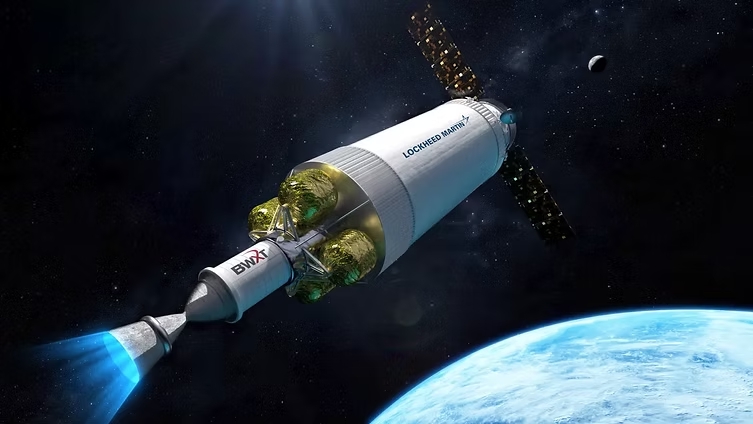
A drawing of a shiny new rocket, as that’s all we’ve got so far. Still…
.
Thanks for reading along!