
When does the bus leave for Mars?
Our solar system is a very, very big place. Happily, we had the good sense to evolve on one of the inner planets (the planets closer to the sun than the asteroid belt), where the distances are merely enormous rather than gigantic, and don’t even get me started on interstellar distances, which are essentially unthinkably vast.
Just to give you a sense of scale, imagine that we could take one of Boeing’s shiny new 737 Max passenger jets and fly it to the sun. It cruises at 850 kilometers per hour, but there’s no air resistance, blah blah blah, so let’s pretend it “flies” at 1,000 kilometers per hour. How long would it take to fly from Earth to the Sun at that speed? Days? Weeks? Months? As long as a year? In fact, it would take just a tad over seventeen (17!) years in an aircraft that circles the planet in just over one day. When we look up at the sun, it just doesn’t look that far away, but it is. Good thing we live in the inner part of the solar system; things get a lot more depressing on the outer side of the asteroid belt.
Mars is an excellent trainer-wheels planet for us. It has a surprisingly useful atmosphere. Gravity is low enough to be very pleasant while still high enough to (hopefully) alleviate most low-gravity health effects. No killer bugs that drill into our skulls and turn us into mindless zombies like here on Earth. No slavering alien space monsters (that we are aware of) to rape our cattle and eat our women. No volcanoes, earthquakes, tornadoes, or hurricanes. It’s not too hot or too cold (relatively speaking), and it’s right next door (relatively speaking). Nice. Comfy.
Of course, “right next door” is merely a figure of speech. At its closest approach, Mars is just a tad less than sixty million kilometers, so our trusty 737 Max traveling at 1,000 kilometers per hour would take six-and-a-half years. Urk. Good thing we are not going by airplane! Lacking grown-up fission or fusion rockets, we’re stuck with good old chemical rockets, which can do the job, but they require us to use a “least-energy” orbit to get us there. It is a surprisingly simple process; assuming you are already in Low Earth Orbit (LEO), you point your ship in the direction that Earth is traveling (hint: around the Sun) and accelerate until you have gained 3.8 kilometers per second (13,700 km/hour). And that’s it. In about seven or eight months, you will be in the same orbit as Mars. That path is called a Hohmann Transfer Orbit. There is one going both ways; there is one for every planet in the solar system, and until we develop grown-up rocket drives, that is pretty much the only way to get around in the solar system.
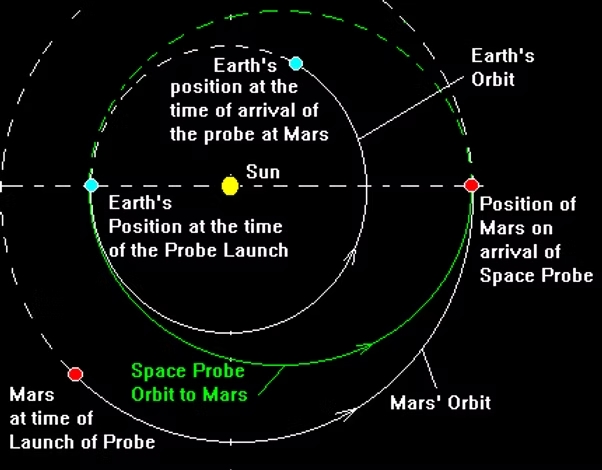
The green line is a Hohmann Transfer Orbit.
There’s a catch, of course. When is there not a catch? “The same orbit as Mars” is not Mars. There is only a very narrow window during which you can leave Earth and transfer to Mars orbit, and upon your arrival, Mars is actually there. Earth and Mars have different orbital periods, with Earth going around the sun fifteen times while Mars goes around eight times (they are in resonance). That means that once every 780 days, you can launch from LEO, and Mars will be there when you arrive in Mars Orbit. That number (780 days) is called the Earth-Mars Synodic Period, and it determines the launch schedule. There is a little wriggle room; you can burn a bit more fuel and get that transfer period down to perhaps five or six months, which also opens up the launch window to thirty to sixty days. But with the current state of chemical rocketry, that’s it.
So the good news is we know how to get to Mars (we’ve made the journey without people dozens of times), and our chemical rockets will suffice if we have nothing better. The bad news is that it will take 6 to 7 months, which has implications for food, water, air, heat, and radiation protection.
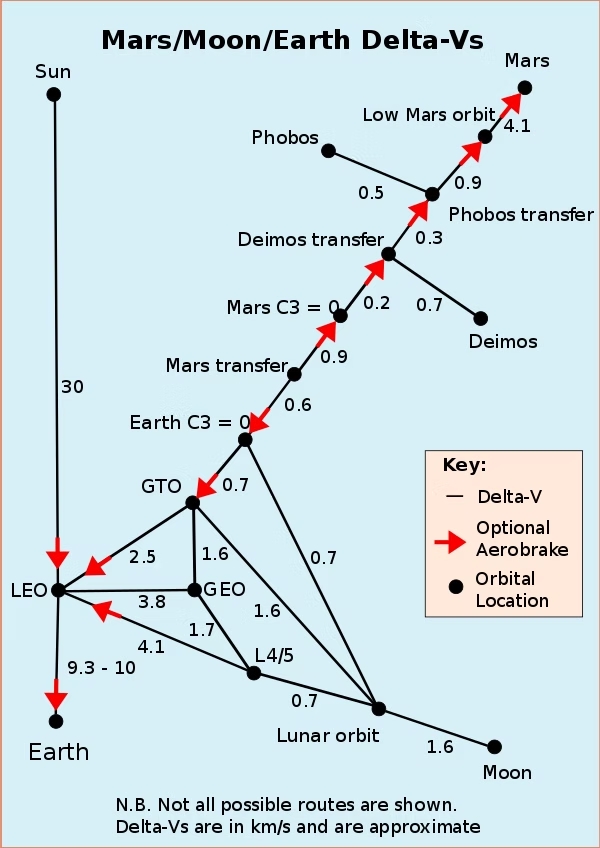
A fun diagram with approximate Delta-Vees for the Earth-Moon-L5-Mars system. Numbers in kilometers per second.
I’m sure you noticed, canny readers that you are, that the above diagram contains several red arrows. Red arrows are good, it means that we can burn off excess velocity by “aerobraking”, which is essentially cheating death by diving into a planet’s atmosphere just enough that we don’t skip off and starve to death while drifting through deep space with no fuel, but not deeply enough that we all die screaming in a melting spaceship (It’s important to aim carefully and don’t mix up metric and imperial units like the NASA engineers did with Mars Climate Orbiter back in 1999.) But it saves tons of fuel! There are no red arrows when going to the Moon as it has no atmosphere to speak of; no atmosphere, no aerobraking. Surprisingly, it takes less fuel to travel from Earth to Mars Surface than to Moon Surface because we can save all that fuel by aerobraking.
So that’s Orbital Realities 101. If you miss the bus, the next one doesn’t leave for another 780 days, and it takes six-seven months to get there. Mildly depressing, but we can do that with our chemical rockets.
But 180 days! That’s a long time to be sitting in a ship listening to Alice humming the same freaking tune over and over and over, and if Bob makes that clicking noise in the back of his throat one more time, I swear I’ll grab a can opener and jailbreak my way out of this thing. And “sitting” will almost certainly be a figure of speech as there probably won’t be anything resembling gravity (hold that thought), which means you’ll be drifting around like a party balloon for months on end, eating everything out of bags and bulbs and paste out of trays, and getting rid of the waste products will be a very careful experience as you certainly don’t want THAT stuff floating around in your cabin for the rest of the trip. And of course, that idiot Leonard WILL forget to close the back-check valve before starting the evacuation pump, so bring a mask.
We can safely say that while the trip is possible, it will be cramped, boring, and uncomfortable.
So, people and their needs. When we talk about “sending a person to Mars,” what does that entail? What constitutes “a person”? Well, let’s use Leonard as an example. There’s him; we know that the average mass of a person globally is 60 kilograms, Europeans average 70 kilograms, and, of course, everyone has to excel at something, so we North Americans average 80 kilograms. Leonard is from Belgium (it is an international effort), so 70 kilograms plus a 5 kg baggage allowance gives us 75 kilograms. Then we will have to bring along everything that Leonard will need to keep him alive, which at a minimum is food, water, and air.
Food is an easy one. The good people operating the International Space Station (ISS) have been running a space-catering business for years, so we can confidently say that Leonard can get by just fine on 1.75 kg of food per day, so 1.75 kg * 180 days = 315 kg of food.
Water is much more complicated, as shown in the diagram below. There is the water moving through Leonard’s body, about 2.5 liters/day, but there is also washing, showering, maintaining a comfortable relative humidity, etc. The ISS has been recovering 25 liters per day from six people, or a bit more than 4 liters per day per person, for the past twenty years, so if nothing breaks, water shouldn’t be a problem. But we all know that the frammis on the hoodjat will break the day after we leave LEO, so an emergency reserve (2.5 liters/day * 180 days = 450 liters = 450 kilograms) would be prudent.
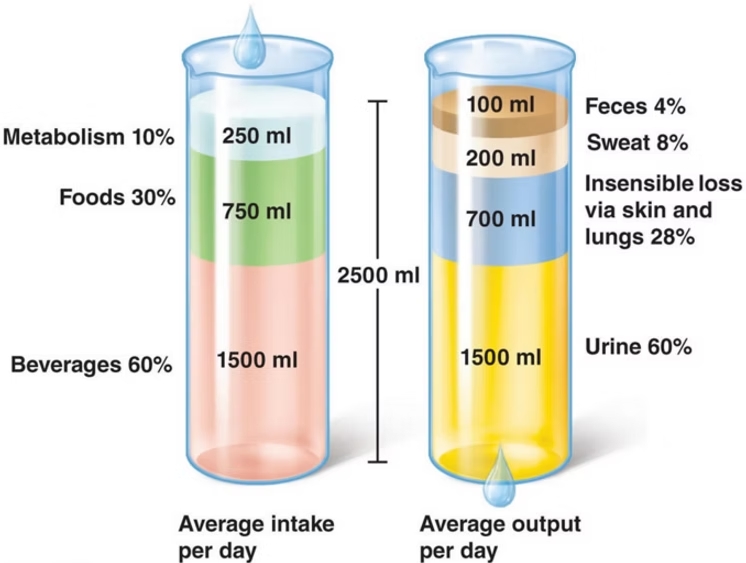
How water moves through our bodies.
Finally, there is air. Breathing is good. Happily, we have over fifty years of submarine technology dealing with the process of creating breathing air out of- wait for it- water! Run a current through water, and oxygen and hydrogen come off the anode and cathode, and collecting the gases is dead simple. The hydrogen can be run through the Sabatier System, which combines it with the carbon dioxide waste gas Leonard produces when he breathes, creating CH4, the rocket fuel the new SpaceX Raptor rocket engine runs on. It’s also the fuel that vehicles on Mars Surface will almost certainly burn, so I’m sure we can find a use for it. Leonard “burns” about 0.875 kilos of oxygen per day, and the ISS has equipment that can routinely generate that amount, but of course, there is always the frammis on the hoodjat, so (0.875*180 = 157.5 kg) equals another 160 kilograms of water for emergencies.
And that is it. One Leonard (we’re applying to make that an International Standard Unit) equals 75 kg of himself + 315 kg food + 450 kg water + 160 kg air = 1000 kilograms. The next question is, how many Leonards can we send in one bus?
Today’s gold standard for moving mass from Earth Surface is the SpaceX Falcon Heavy, which is rated to carry 63,800 kilograms to LEO and 16,800 kilograms to Mars Surface. Yes, I know, I know, Starship and the Chinese and maybe Blue Origin in a few years, but TODAY, FOR SURE, we can yeet 16,800 kg from here to there with an existing machine. (Pretty impressive, actually.) That’s terrific, now we need to pick a craft that our Leonards can live in. Leafing through the brochure, the number of reasonably available spacecraft appears to be… none. There is an airtight people-can out there called Crew Dragon, which SpaceX uses to move people to and from the ISS, but it has some serious shortfalls that would need to be rectified before it could travel to Mars. It needs landing legs, it has no long-term life-support systems, and it is too small to carry people and cargo on an extended journey. In my opinion, at least one of these ultimately isn’t fixable. Crew Dragon has an internal volume of 328 cubic feet, roughly a room 7x7x7 feet, and there is no way we are going to fit a herd of Leonards, a couple thousand kilos of cargo, and several life support systems into that space. So, we currently don’t have a craft that can take our Leonards to Mars.
We COULD attach a habitat to Crew Dragon that would resolve the living space, cargo storage, and life support systems. Crew Dragon has an airlock connection, so it would be a trivial issue to attach a habitat, live in it en route to Mars, and then leave the habitat in Low Mars Orbit (it has obvious future utility) and use the Crew Dragon to land on its shiny new legs. But of course, a habitat will weigh a lot, and now we don’t have enough fuel to get everything to Mars.
Rats. So, we need a rebuild, a rethink, or both. Don’t get discouraged, space is hard. If this were easy, someone would have already done it, but that does not mean it cannot be done.
The easiest way to address this is to launch the Falcon Heavy to LEO with no payload. That results in the Falcon Heavy’s second stage, which weighs just under 4 tons, having 85.5 tons of fuel onboard when it reaches LEO. 85.5 tons of fuel will take 35 tonnes to Low Mars Orbit, and since the Crew Dragon plus four Leonards plus a full load of hypergolic fuel for landing weighs 15 tonnes we can now send an additional 20 tonnes to Low Mars Orbit, which sounds a lot like a customized Dragon XL (yes, there is such a beastie, at least in the fever-dreams of SpaceX engineers) with an airlock that attaches to the front of Crew Dragon.
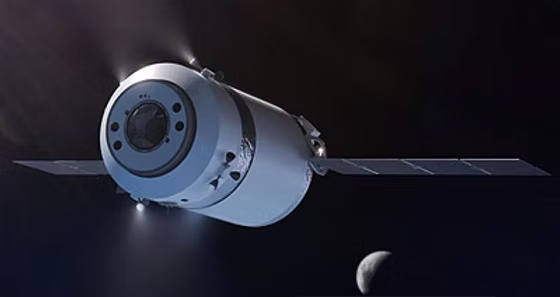
An Artist’s Rendering of Dragon XL
Once we have a Falcon Heavy second stage sitting in LEO with 85.5 tons of fuel, we can send up two Falcon Nines with the actual payload. The first one would carry a Crew Dragon, four Leonards, and a full load (2600 kg) of hypergolic fuel. That would weigh 16,200 kg, well below a Falcon Nine’s capacity of 22,800 kg. The second Falcon Nine would carry the modified Dragon XL, which could weigh up to 18,200 kg with a maximum dimension of roughly 5 meters in diameter and 15 meters in length, as it needs to fit inside the Falcon Nine’s large fairing. The currently designed Dragon XL weighs roughly 14 tons loaded, so there’s lots of room for increasing the pressurized volume, adding the life support systems, etc. Once everything is in orbit, attach the Crew Dragon to the fueled Falcon Nine second stage (the clamps are already there), attach the Dragon XL to the front of the Crew Dragon (it’s a standard airlock mechanism), and you have a ship that’s ready to go to Mars! Once the craft is in Low Mars Orbit the Crew Dragon detaches from the Dragon XL, which is an excellent and ongoing resource in orbit (think Low Mars Orbit space station), and the Falcon Heavy Second Stage (which is still a perfectly functional pusher unit that just needs fuel to be reused), and proceeds through aerobraking and its internal engines to land on Mars Surface. Yay! We got four Leonards to Mars!
The bad news: all the Leonards will now die. They are sitting on Mars Surface in a vehicle that has no fuel and can’t be refueled, as they are designed to burn special fuels (hydrazine). The Leonards ate all their food on the trip from Earth, and they have no supplies left. So we need to send another Crew Dragon to keep them alive for the twenty-six months until another Crew Dragon shows up to keep them alive for another twenty-six months until… So, a qualified success at best. We could overcome this to some degree by sending a fleet, perhaps four Crew Dragons plus Habitats and another eight or so Cargo Dragons, which would give us a dozen craft on the ground for the sixteen Leonards to modify into habitats.
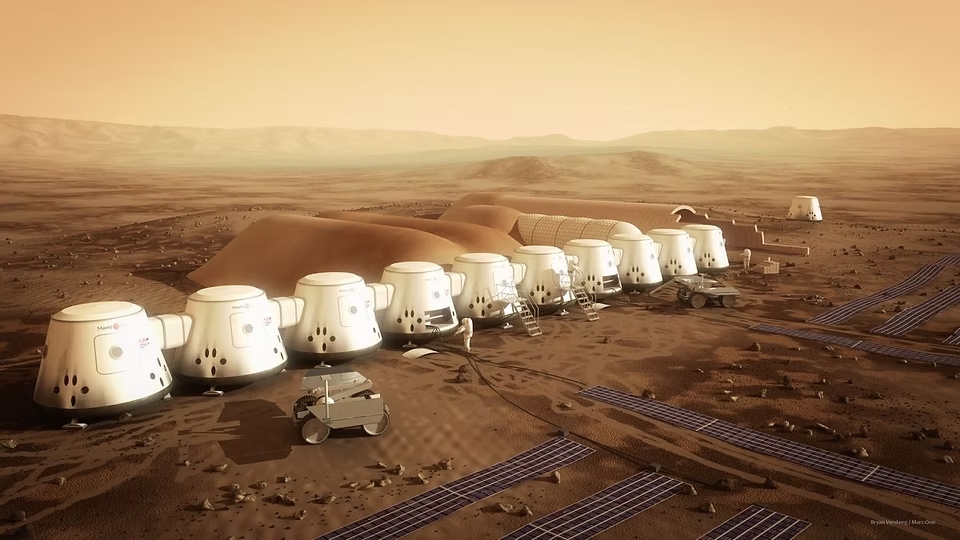
Artist’s depiction of a flock of Red Dragons on Mars Surface.
So we could make it LOOK like colonization, but it isn’t really. I just described the history of Canadian colonization, by the way. Small groups of European 17th-century Leonardos watched their ships sail back to Europe in late summer, and the ones who didn’t starve or freeze to death or die of disease got to die anyway if the ships didn’t return the next year, which they sometimes didn’t. Colonization has always been hard.
Establishing a colony in Low Mars Orbit would be MUCH easier, as we already have the Dragon XLs and the pusher-units in Low Mars Orbit, and we don’t have to solve the ‘Landing And Taking Off Problem’. So, are we going to go with these ships? Almost certainly not, but the thought exercise demonstrates that we COULD make it work if we had to. It’s not an insurmountable obstacle. The basic problem is we don’t have a big enough craft to get decent-sized equipment and materials to Mars Surface, and we need decent-sized equipment if we are going to build a viable community.
Elon Musk figured all this out a long time ago. We need his Big-Ass Spaceships if we are going to have any chance of pulling this off. My next posts will discuss a few options for making the trip more quickly, more comfortably, or both.