
There ARE other places out there in the Solar System where humans might be able to live long-term. Here’s a few of them to consider, working our way from the bottom of the Sun’s gravity well outwards.
.
Mercury
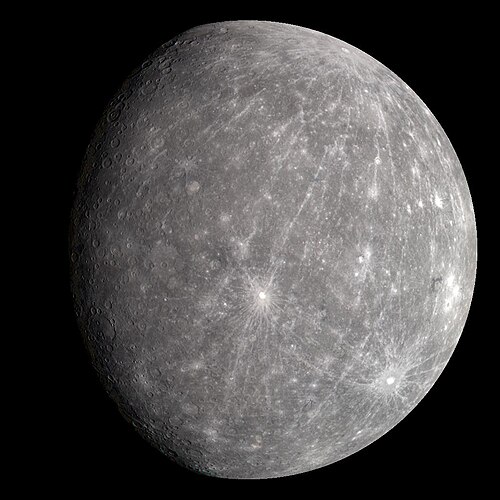
Mercury as captured by Messenger spacecraft, 2008.
.
Seriously? No.
The surface temperature is 425 C on the sunward side (it’s tidally locked to the Sun, so one side always faces it), and -175 °C on the shaded side. Almost no atmosphere. Intense radiation. And it’s near the bottom of the Sun’s gravity well; the delta-vee to return to Earth is almost 11 kps, assuming aero-braking.
Is it possible that there are less extreme conditions at the sunlit/shaded terminator, or near one of the poles? Yeah, possibly. But why would we go?
A very unlikely candidate.
.
Venus
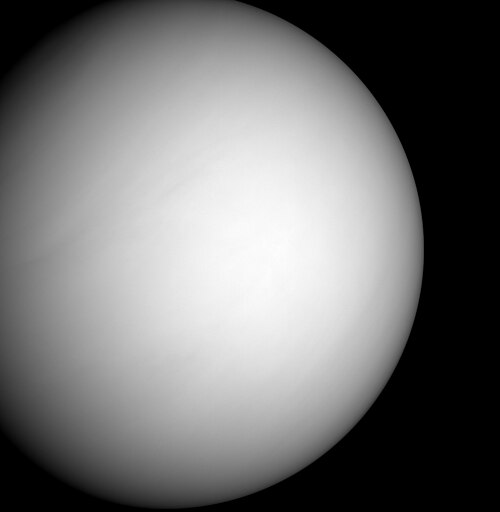
Venus as captured by Messenger spacecraft.
.
Not the surface, ever. Venus has a crushing atmosphere, 1350 psi, like being a kilometer deep in Earth’s ocean. And the temperature down there is over 450 degrees C.
The cloud layers, however, are a different story. Venus has extensive clouds, which are arranged in three distinct layers from 40 to 70 kilometers above the surface. At 50 kilometers, the atmospheric pressure is the same as Earth at sea level, and the temperature is Earthlike, between 0 °C and 50 °C. So, it is the most Earth-like of all known habitats in the Solar System. Of course, the air is CO2, and the clouds are sulphuric acid, but who are we to quibble? Also, our ‘normal’ atmosphere of 20% oxygen/80% nitrogen is a ‘lifting gas’ in Venus’ upper atmosphere, so no worries about ending up cooked and crushed on the surface, provided that the sulphuric acid clouds don’t eat our blimp.
So why is it a long-shot? Well, there’s no water in the atmosphere, so it would all have to be brought in from somewhere else. And there are no building materials, so ditto. And finally, what would be the purpose of a colony? It’s difficult to envision it as self-sustaining, and it’s not producing tangible products, so why?
.
Ceres
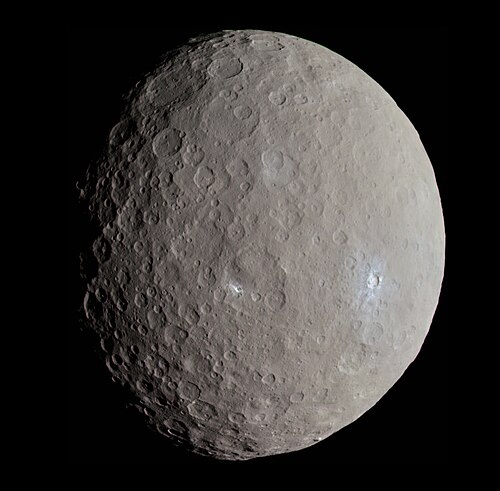
Ceres as captured by Dawn spacecraft, 2015.
.
Dwarf planet? Asteroid? Perhaps a little of both, Ceres is the largest body in the asteroid belt, making up at estimated 40% of the total mass of the asteroid belt. At 940 kilometers in diameter, it qualifies as a dwarf planet, but it’s chemical makeup is similar enough to the carbonaceous chondrite meteorites to qualify it as an asteroid. Besides, it’s in the asteroid belt. Unsurprisingly, Ceres doesn’t care what we call it. It just is.
It contains large quantities of hydrated minerals and clays, is very carbon-rich, and is estimated to be 20-25% water ice. Surface gravity is 3.5% of Earth’s, which is very weak, but things WILL stay where you put them if there isn’t a fan on. Surface temperature is -120 °C.
So why is this a candidate? Firstly, it’s easy to live in. You dig a hole and start picking out colors for the bathroom. There’s ample water, and with clays and hydrated minerals, there’s probably everything you need to make drinking water, air, and rocket fuel, and to grow food. Sunlight intensity is 157 watts per square meter. To put that into context, a current Starlink V2 Mini has 116 square meters of panel, and would produce just under 5.5 kilowatts of electricity at today’s 30% efficiency. So there’s no shortage of potential available power.
That all sounds pretty good, so why is it a long-shot? Well, there’s nothing there that you couldn’t get on Mars, which is a lot closer and has a useful atmosphere. Further, Ceres’ orbit is significantly inclined, which means you need to expend more energy matching orbits. So total delta-v from Low Earth Orbit is in the 10-15 kps range, and one-way trip time is 18 to 24 months, which means you need to pack a LOT more food, water, air, etc.
Once other colonies start up (eg Lagrange Point 5), there will be a business case for Ceres’ resources. Delta-v from Ceres to L5 is less than from Mars, which is MUCH less than from Earth. And once you can make a buck, someone will go there and do just that. But until other colonies start up, or until people start seriously exploring the asteroid belt and need a truck stop along the way, it’s hard to make a business case.
That’s it for the Inner Planets. The standout candidates are Geosynchronous Stationary Orbit and Mars, with Lagrange Point 5 a strong follow-up candidate. I’ll discuss them in more detail in subsequent posts.
Thanks for reading along!