
Every two-body system (eg Sun-Earth, Earth-Moon) has five Lagrange Points, which are stable or semi-stable ‘parking points’ where the gravity of the two bodies roughly balances each other out. L1 and L2 are directly in front of and behind the smaller body, respectively. L3 is behind the larger body. L4 and L5 are 60 degrees ahead and behind the smaller body in its orbit. In the case of the Earth-Moon system, the L4 and L5 points are stable (once you put something there, it stays there), and it takes very little delta-vee to come and go from them ONCE YOU ARE IN ORBIT.
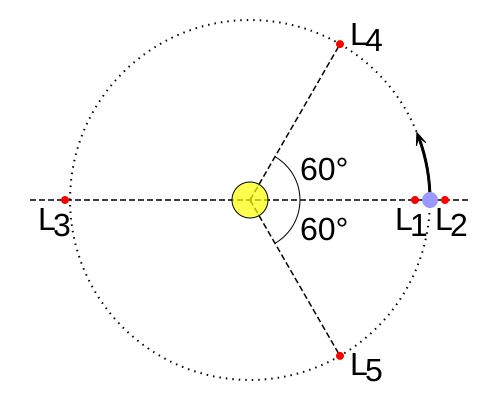
The 5 Lagrange Points. In the Sun-Earth system, the Sun is yellow, Earth is blue. In the Earth-Moon system, the Earth is yellow, and the Moon is blue (no really).
For example, travelling from our theoretical colony in the vicinity of Geosynchronous Orbit to Lagrange Point 5 (L5, the trailing point in the Earth-Moon system) would require roughly 1.7 kilometers per second. If you want to go in a hurry, it would be more. If time is not an issue, it could be less. But that’s a good number to work with. And once you’re there, the energy needed to travel to Luna, Mars, and indeed back to Earth is very small. The sun shines 24/7/365 at 1360 watts per square meter. You can generate electricity and grow food. Life is good.
What that means in practice is that the Earth-Moon L4 and L5 points are serious contenders for colonies in the longer term, but we need to establish a presence in space first, before they make economic sense. For example, shipping iron ore from Mars Surface to L5 would cost 1/3 to 1/2 the price of bringing it up from Earth Surface. But first, you gotta have a colony on Mars that wants to sell it to you!