
December 16, 2014 – Angkor Wat
This is our one day to see Angkor Wat (and a few associated sites), so we are determined to do it right. That means a professional guide plus a tuk-tuk for a full day, and it’s a 7 am start. That’s going to cost just over $100 for the day, as there is a $20 charge to get into the park, but if you want to know what you’re seeing, pay the money. Oh, and they’ll find your bleached bones out there if you don’t hire transportation.
The entire complex starts only about 5-6 km north of Siem Reap, and it is huge, covering at least 100 square kilometres. Only a portion of it has been uncovered and restored, and the world will likely be at it for at least another 50 years. The Khmer built it starting in the 10th century, the Empire peaked in the 13th and 14th centuries, and the whole thing collapsed in the mid-15th century due to the same climate change (global cooling) that took out the Mesoamerican and Viking empires. Their architecture makes the Mayans look like a bunch of yokels, their statuary and bas-reliefs rival anything done in Europe, and their engineering (particularly hydraulic) rivaled anything on earth. Then it all went away, and the jungle took it back until the 1930s when a French explorer “discovered” it (the locals told him about it, so he went for a look-see). But nothing much really happened to open it up to the world. There was serious angst amongst the archaeological community during the Pol Pot days as his merry little band of xenophobic, nihilistic arseholes was camped out around there, but apparently they couldn’t figure out how to kill rocks and stones, so they left it alone. After that foolishness was all settled, the international community started putting all the rocks back up (an astonishing 3-D puzzle!), and thirty years later, Debbi and I are about to conduct a snap-audit to see how things are progressing.
Our guide for the day is Mr. Sam, who has been a professional guide for three years. Like all guides, the Park tested and licensed him, and like all Cambodians, he is friendly, gracious, and kind-hearted, and he just wants to hug everyone. (The people here really are pretty much all like that.) Once we clear the turnstile at the park entrance, it’s a couple of kilometres drive through the forest until suddenly the road turns and runs beside the perfectly square artificial lake that surrounds Angkor Wat. The temple complex is at least 600-800 metres across, and the lake is another hundred metres wide, maybe more. It’s big. Mr. Sam drove right by it. He says that it is overrun with tourists in the morning, and that we will visit it in the afternoon when the light is better for photos. OK, I guess that’s what we have a guide for! Instead, we drove north a couple of kilometres to Angkor Thom, which makes Angkor Wat look teensy. You get there via a bridge across another artificial lake, which surrounds Angkor Thom, except this place is 3-5 kilometres on a side. The major stop was Baphuon, which is some combination of temple and public building. 100 metres on a side with 16-foot sidewalls and a temple on top, the outside wall (400 metres!) is filled with bas-relief carvings of war, peace, sports, gambling, religion, etc. A complete description of life at the time. Then there is a 200-metre walkway with a central stage for rock concerts (ROCK concerts, get it? Sigh. Never mind.) or whatever. Oh, and it was all surrounded by an enormous reflecting pool. Wow.
(Reminder: To see images full-size, right-click on the image and select ‘open image in new tab’.)

Baphuon from the (empty) reflecting pool. It would be nice to see this full of water one day!

A hunting scene. Note the intricate detail carved onto the stones below. There are a couple of hundred meters of these carvings!
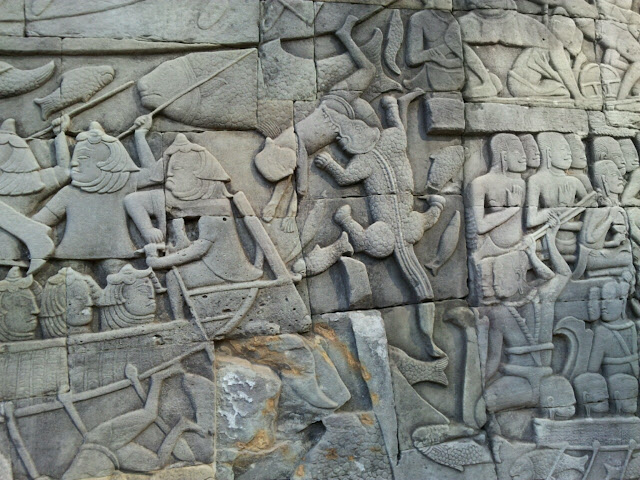
Apparently, crocodiles were an integral part of canoe warfare…
We made 3-4 more stops in AT, but as you drive through the forest, there is another undisturbed pile of rocks every hundred metres or so. The place is a mass of ruins. I hope they are well enough catalogued one day to see what the city was like!
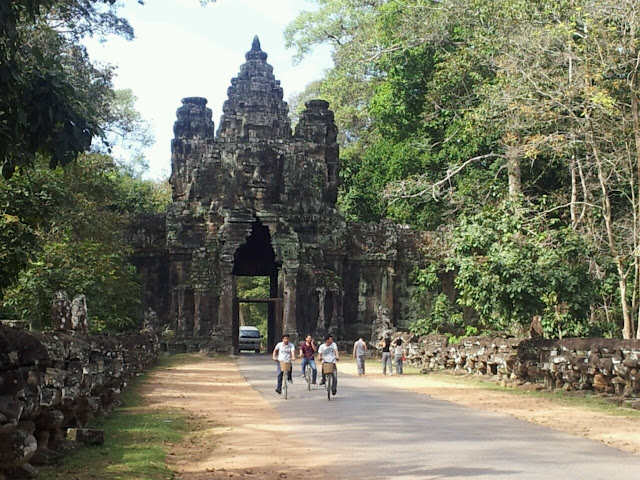
East gate of Angkor Thom from the bridge. Note the face above the gate.
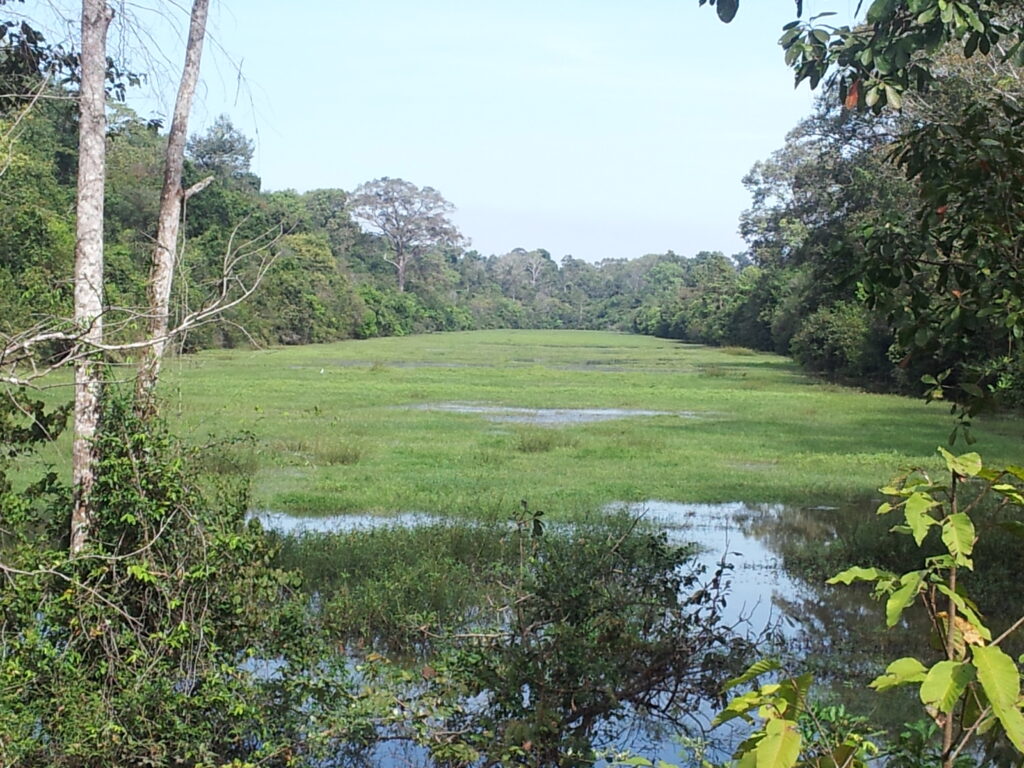
The canal surrounding Angkor Thom, from the same spot as the previous photo.
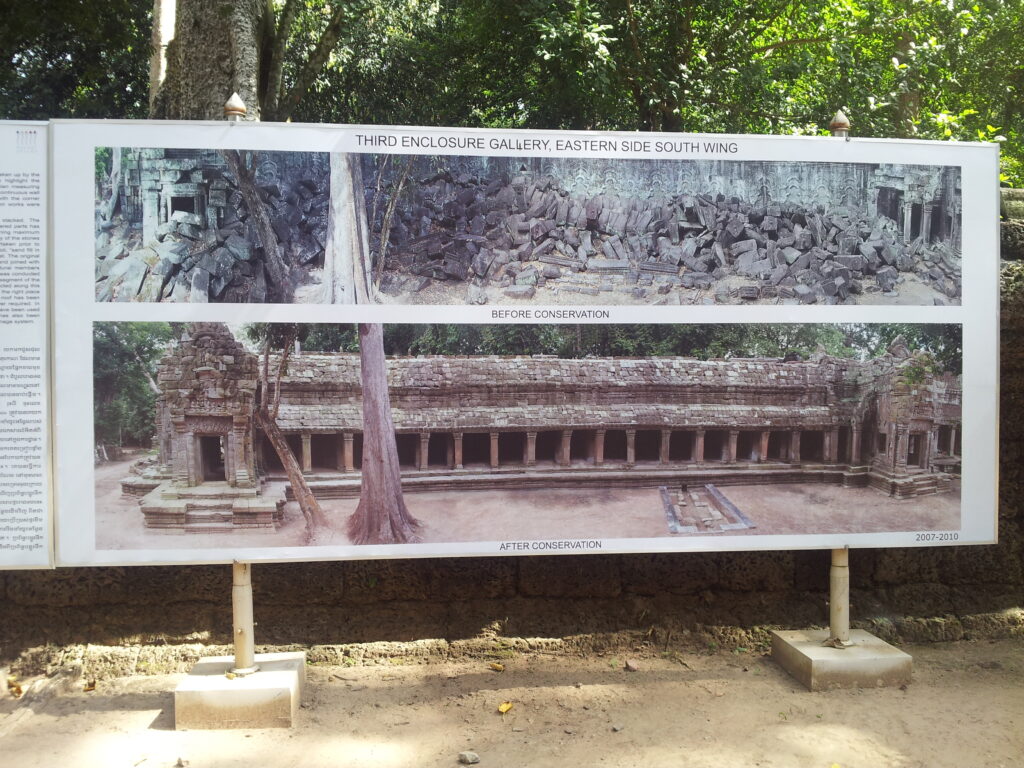
If you get frustrated doing jigsaw puzzles, don’t get a job here. Incredible job.
Next was Ta Prom, which is in the process of being dug out and re-piled by the Indian government. This is where scenes from Tomb Raider were shot. Mr. Sam is still significantly indignant that most tourists just want to see the Tomb Raider Place. “They wanted to use monkeys! We have no monkeys!” It is a seriously cool feast for the eyes. In many places, enormous 100-150-foot trees have grown into the ruins and are now part of it. The trees can’t stand without the ruins, and the ruins can’t stand without the trees. It’s serious camera country.

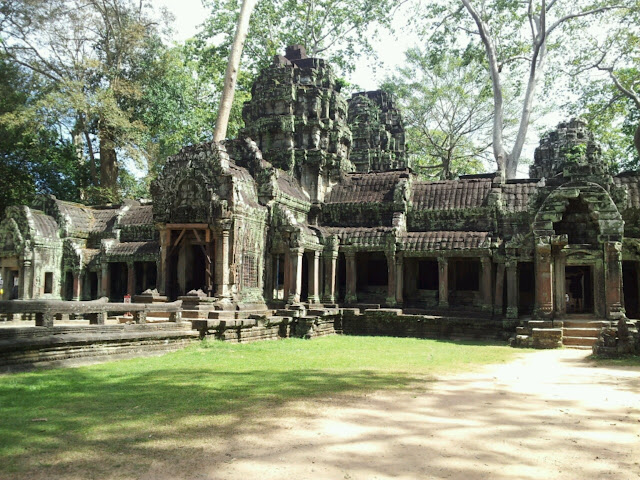
Tomb Raider! Still no monkeys.
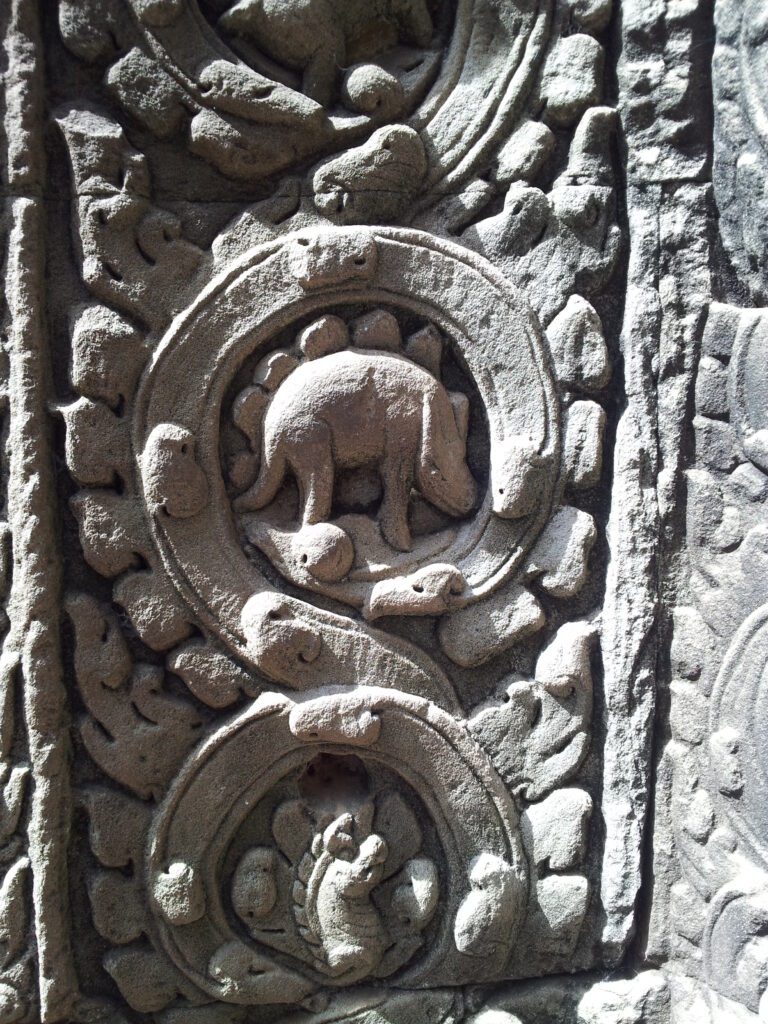
If that ain’t a Stegosaurus I’ll eat my pterodactyl.
Then it was time for an excellent lunch on site and off to Angkor Wat. Mr. Sam was right; the light was perfect in the afternoon, although it was seriously hot. We limited ourselves to about 2 hours there, as it was just too draining. Deb went up two levels, and I went right to the top, which is probably 150-200 feet above ground level. That top level is up a serious flight of stairs. When I got to the top, I found it was at least 100 metres across with four swimming pools (ok, they might be duck ponds), shrines, walkways, etc. Back on the lower level with Deb and Mister Sam, we followed a series of bas-reliefs that depict a serious falling out between two clans that is enormous and exquisitely detailed, worth the trip all by itself. Then it was out to the front yard to snap some photos over the reflecting pond, and time to find a beer and some air conditioning.
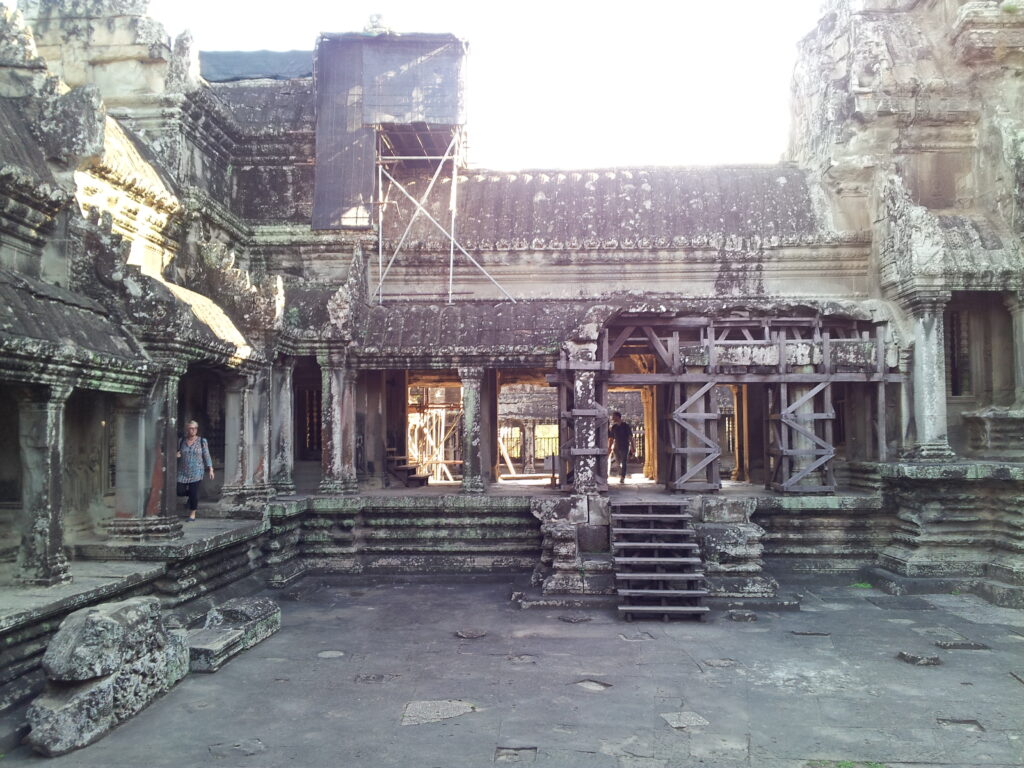
Duck pond in foreground, with another one behind the ‘passageway’. There are four of them up there.
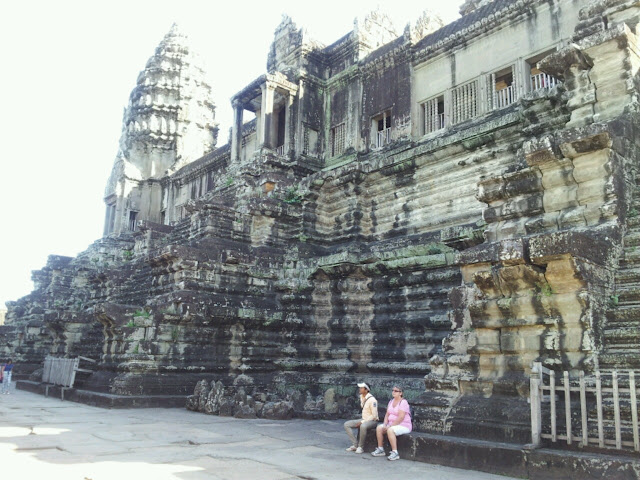
Deb and Mister Sam are taking a break on the second level.
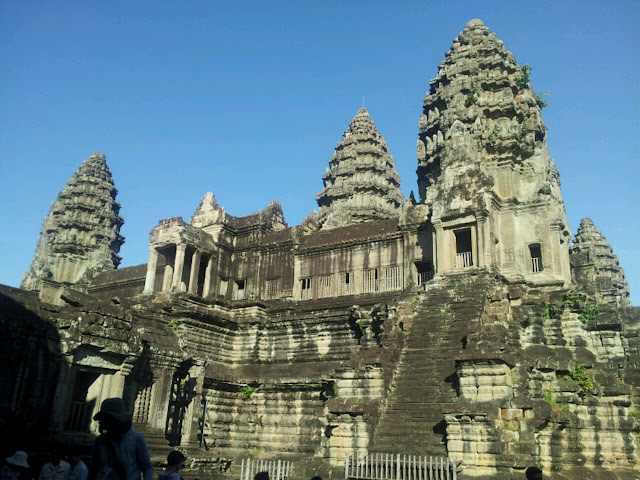
The upper level from the inner courtyard, the library on the lower left.
The thing they don’t discuss (seriously disappointing to us geeks) is the hydraulic engineering that made this all possible. They dug out literally dozens of square kilometres of artificial lakes, all connected, complete with pumps and locks, to serve as fish ponds and water reservoirs for rice harvesting. That’s why they could support such an enormous population. Sadly, like humans always do, they built up their population to 100% of the carrying capacity, and then when a series of large droughts took out their society. (Anybody listening, USA? How do you spell Oglala Aquifer?) But that’s all for another day, maybe once they get everything dug out, they’ll start talking about the humble engineers instead of the kings and nobles…
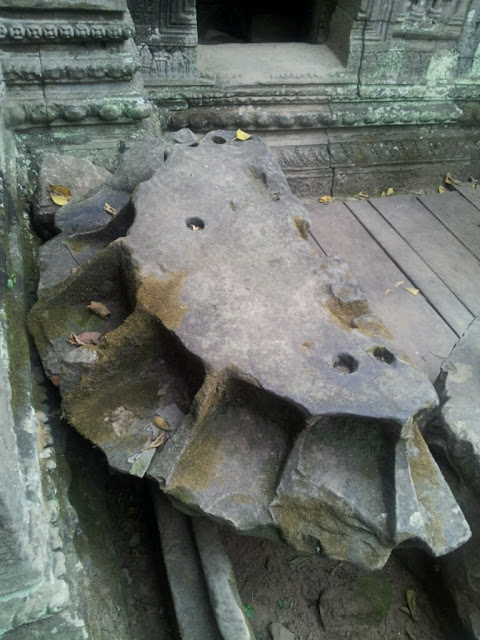
A roof keystone, carved in one piece from a rock.
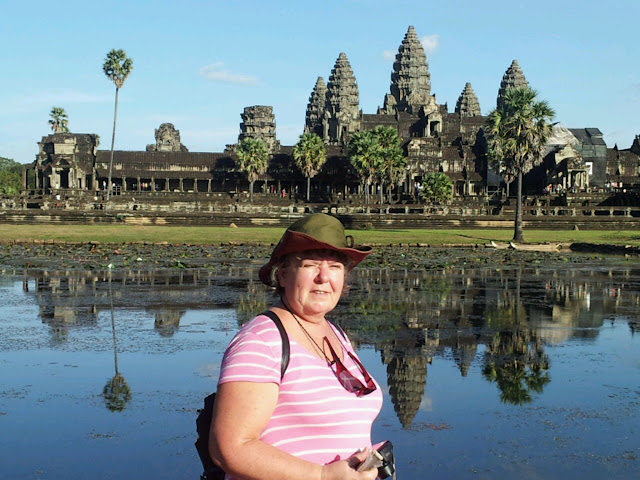
Truly, we have been there. Looking across the reflecting pool.
It’s an incredible place. Go and see it if you can. You don’t have to climb much, but if you want to see the top of things, it can be strenuous, and some stairways are daunting. Go early, take 2-3 days if you can, a guide helps, and transport is essential. Have fun!