
December 15, 2014 – Siem Reap
Well, here we are in beautiful downtown Siem Reap. Every day is an adventure around here.
We decided to take the bus up here from Phnom Penh and to return on the boat, that way we’ll be sure not to miss anything. The locals in PP all told us that Giant Ibis was the best bus line to use, so that’s who we got. They are better buses than you see in BC, somewhere around First Class in Mexico. Free wifi, air conditioning, good seats, in-flight movies, and a snack. Not bad for the roughly $2-3 per hour it costs to ride on them…. The bad news: the main highway from PP to Siem Reap is really the shits. The first two hours are under construction as they are upgrading to a four-lane highway, and the rest is narrow and full of potholes. 300 km took us 7 hours! Looking on the bright side, that gave us a really good opportunity to see life in the country. The roadside is an almost unbroken string of farm houses (a charitable description) and small towns. Pretty much everything is about rice here, and the people are dirt-poor. About half of the farmers have access to a ‘tractor’ which looks like a giant roto-tiller, which can be adapted to pull just about anything. The farmers use them to cut the rice down, which still has to be bundled and loaded onto trailers by hand. Those are the rich and/or lucky ones; the rest still cut their rice with a hand-scythe just like their ancestors did 1000 years ago. Pretty amazing to see in this day and age. These folks are poor. We saw a few clusters of solar panels on the roofs of farmhouses, perhaps a hundred or so in our seven-hour trip, and it was explained to us that those belonged to the rich families. The other folk, if they were lucky, had a car battery in the house that delivered power for lights, maybe a small TV, and for charging phones. The batteries are taken to the charger guy and filled up for $0.50 whenever they can afford it. Such is rural electrification; if the government hooked everyone up to power, there wouldn’t be enough juice to run the system, and the homeowners couldn’t pay for it anyway. They are facing a long climb out of the hole they found themselves in after Pol Pot and the Khmer Rouge.
Siem Reap is a completely different kettle of fish. It’s basically a couple of villages that exploded into a tourist town to service the enormous complex of ruins just a few kilometres to the north, which is of course why we came here too. Nowadays, you don’t have to endure the bus ride from Phnom Penh or (even worse) Bangkok; they have an international airport, and you can fly right from Vancouver! There’s a nice river running right through the middle of town that has been prettied up into a canal of sorts, and with the trees and bridges, and decorations, it’s very nice and peaceful in a French Colonial sort of way. We’re staying at the Angkor Orchid Central Hotel, which is on a quiet side street about a block from the river. It’s a nice big room, excellent, friendly and helpful staff, complimentary breakfast with terrific coffee, all for $21 per night. The only downside here was the bathroom shower, which is IN the bathroom, and you get water everywhere, no matter what you do. Oh well. We wandered the town in the morning, which is very interesting and much cleaner than Phnom Penh, but it is also a bit of a tourist trap. On the other hand, tourist traps can be good sometimes! This one includes a one-block section called “Pub Street” which is an unbroken string of restaurants, bars, karaoke places, massage parlours, and whatever else a happy tourist would want. Very interesting.
(Reminder: To see images full-size, right-click on the image and select ‘open image in new tab’.)
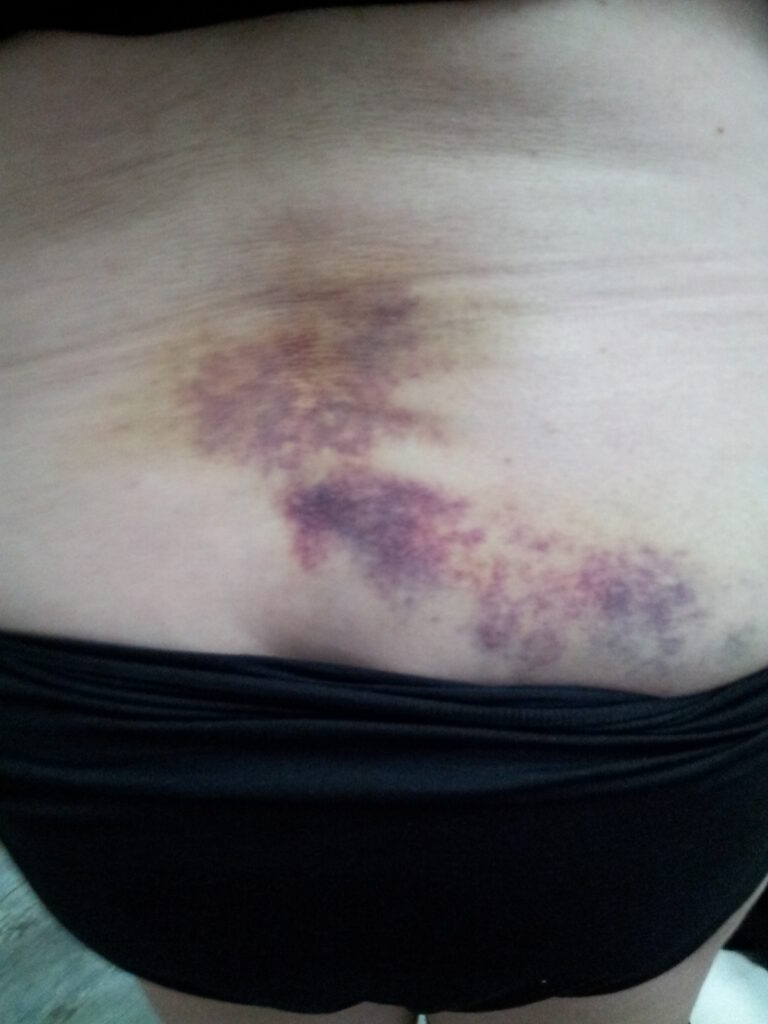
It’s a few days since Deb’s fall, and much of the pain has gone. But the bruises certainly haven’t!
This afternoon is our first adventure! We’ve booked a half-day tour which includes a visit to a craft village sponsored by the government, a boat trip through an isolated fishing village, and a sunset viewing by boat on Tonle Sap Lake. The craft village (actually right inside Siem Reap) was pretty cool. The government is trying out a program where they teach/sponsor/facilitate villages becoming craft centres, provide them with health care and other benefits, and the wealth created will hopefully keep them from moving to the city. Social engineering at its best, I wish them luck! In any event, we’re not talking knick-knacks here; some villages are stone carving monumental images as part of the refurbishment program for Angkor Wat and other temples (that’s a permanent job, believe me), others are doing high-end lacquerwork or silk paintings or several other things. All very interesting and beautiful, and of course, there is a sales area…
The trip to the fishing village was truly an adventure. First, we piled into a twelve-passenger van for the trip down a one-lane (paved) side road until we eventually came to The Last Place To Take A Whiz. After that, we followed along a river/canal on a one-lane dirt road surrounded by rice fields. The dirt road turned into a dirt track, and eventually we came to a bunch of clapped-out wooden boats all jammed into the creek channel. By now, we’re about 5km from TLPTTAW, and we’ve realized that that was the high-water mark when the lake fills up! After much back-and-forthing the locals finally figure out how to get us into the boat, the skipper lowers the propeller about 2/3 into the water, and off we go down the river, snaking our way around people throwing fishing nets, other boats, rice farmers running irrigation pumps, families taking a bath, etc.

Walking the gangplank, then down the small boat to the big boat
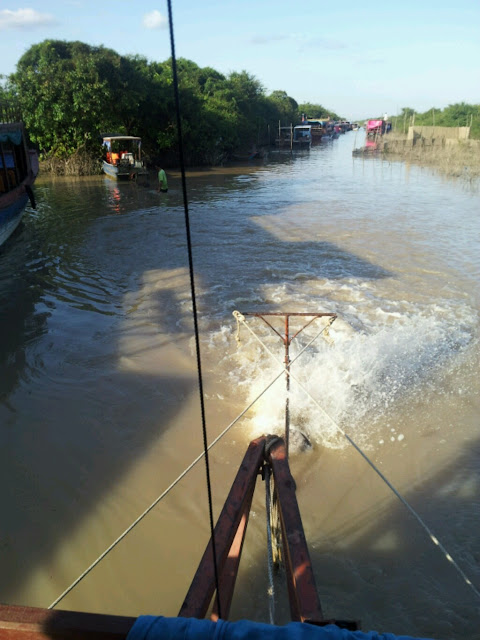
The propeller can be raised or lowered with rope.
Eventually (perhaps another three km), we get to the village, which is, I must say, extremely cool. Around the end of the Khmer Rouge thing, eighty-five families secured permission to live out here where nobody would bother them (shoot them, cut their heads off, run over them with water buffalos, that kind of bother), and since then the village has bloomed to about 3000 people. It sports a police station, a Buddhist temple, and a few other public buildings. No power or running water, of course. And it’s all jacked up about twenty feet in the air, as that’s how much the lake will come up during the rainy season. Apparently, during high water the cows get boarded out, the chickens have cages that hang off the side of the buildings, and the ducks can look after themselves. The whole thing has a kind of surreal quality to it, something like The Postman crossed with Road Warrior, but I guess it’s working just fine. They do a lot of fish farming in barge-things that are half-sunk in the water, in addition to ‘normal’ fishing, and they sell enough fish to be considered prosperous in this part of the world.
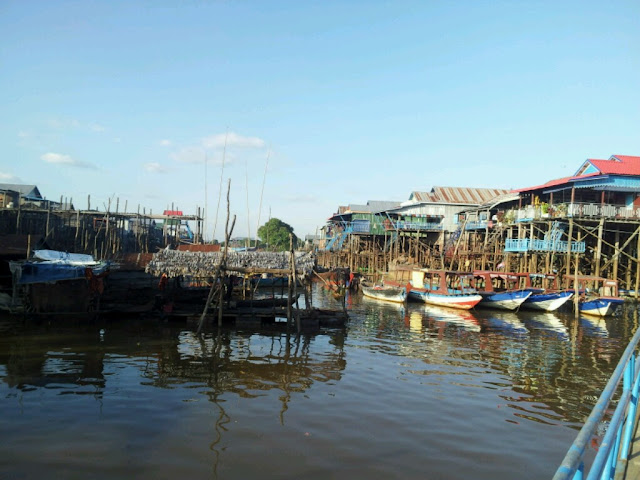
Entering the village.

A young girl standing on top of her family’s fish farm.

The village from the pagoda.
As we left the village, we pootled down through a kilometre of drowned (but very healthy) forest, which was very picturesque, and of course the locals have slapped up a couple of restaurants and they offer to paddle you through the forest for a couple bucks.

Looking through the perfectly healthy forest-in-the-water.
Then it was off to Tonle Sap for the sunset thing. Lake, sunset, what can I say? The only remarkable thing was that several pretty young ladies were earning a good living running their sampans between tour boats, selling beer and snacks. Free enterprise at its best!
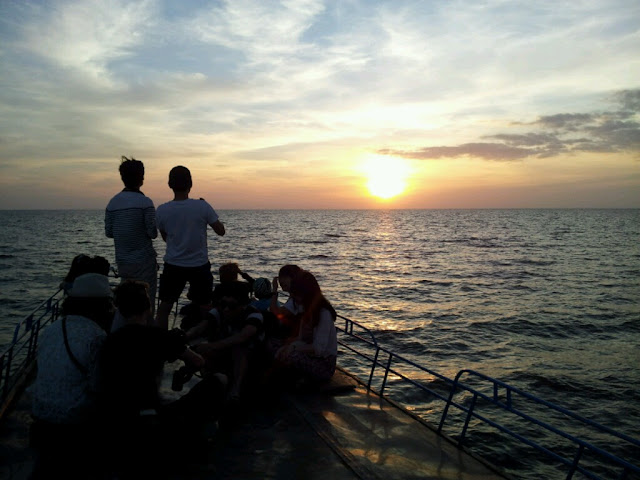
Then it was time to do the whole thing in reverse, but in the dark, which added a whole new element. Eventually, they dropped us off at our hotel around 7:30, and it was indeed a pretty good day.